
I have traveled solo through 47 countries on six continents. I have taken night buses in Bolivia, walked through medinas in Morocco, ridden motorcycles in Vietnam, and hiked alone in Patagonia. The vast majority of those experiences were wonderful. A few were uncomfortable. None were catastrophic.
The world is mostly safe, and people are mostly good. That is not naive optimism — it is the statistical reality confirmed by millions of solo female travelers every year. But "mostly safe" is not "always safe," and preparation matters. The goal of this guide is not to frighten you out of traveling. It is to equip you with practical tools so you can travel with confidence and awareness instead of anxiety.
This guide is honest. It does not pretend that risk does not exist. It also does not exaggerate risk to the point of paralysis. The space between those extremes is where good preparation lives.
Before You Go: Research and Preparation
Research Your Destination's Safety Landscape
Not all destinations present the same risks, and the risks that exist are often different from what you expect. Research specifically:
- Common scams targeting tourists (not just women — general scams are more likely to affect you than gender-specific threats)
- Areas to avoid at night, or neighborhoods with poor reputations. Every city has them. Knowing where they are means you can simply avoid them.
- Cultural norms around gender, clothing, and behavior. Understanding these is not about conforming to every local expectation — it is about making informed choices.
- Local emergency numbers (not always 911 — in Europe it is 112, in the UK it is 999, in Japan it is 110 for police and 119 for ambulance)
- Your country's embassy or consulate location and phone number at each destination
The best sources for this research are:
- Solo female travel blogs and forums — women who have recently visited your destination and share specific, practical safety observations
- Reddit communities (r/solotravel, r/TwoXChromosomes travel threads) — real accounts, not sanitized guidebook advice
- The Smart Traveler Enrollment Program (STEP) for US citizens — register your trip with the State Department and receive alerts about safety conditions at your destination
- Local women's perspectives — when possible, read articles or watch content by women who live in the country you are visiting, not just tourists passing through
Share Your Itinerary
Before you leave, share your full itinerary with at least one trusted person at home. Include:
- Flight numbers and dates
- Hotel/hostel names, addresses, and phone numbers
- Your phone number abroad (if using a local SIM or eSIM)
- A check-in schedule ("I will message you every evening by 9 PM local time")
If you deviate from your itinerary, update your contact. This is not about surveillance — it is about ensuring someone knows where you are in the unlikely event that something goes wrong.
Travel Insurance
Solo travelers do not have a travel companion to help manage a medical emergency, theft, or trip disruption. Travel insurance is not optional for solo travel. Get a policy that covers:
- Emergency medical treatment and evacuation
- Trip cancellation and interruption
- Personal liability
- Adventure activities if applicable (many standard policies exclude motorcycle riding, the most common cause of tourist injuries in Southeast Asia)
Digital Safety Setup
Before departure, set up these digital safety measures:
- Enable "Find My" or "Find My Device" on your phone. If stolen, you can locate it, lock it, or erase it remotely.
- Set up emergency SOS on your phone. On iPhone, press the side button 5 times. On Android, the process varies by manufacturer. Test it before you travel.
- Save emergency contacts in your phone under "ICE" (In Case of Emergency). First responders worldwide are trained to look for ICE contacts.
- Share your live location with a trusted person using Google Maps, Apple Maps, or WhatsApp location sharing. You can set it to share for a specific duration (e.g., 8 hours while you are out exploring).
- Back up your phone to the cloud before you leave. Photos, contacts, and documents are recoverable even if your phone is stolen.
- Have digital copies of all important documents (passport, visa, insurance, prescriptions) saved in your email and a secure cloud drive.
Accommodation Safety
Where you sleep is the foundation of your daily safety. Choose wisely.
Choosing Safe Accommodation
- Read reviews from other solo female travelers. On Hostelworld and Booking.com, filter reviews by solo travelers. Look for comments about security, neighborhood safety, and staff helpfulness.
- Choose accommodation in well-traveled areas for your first night, especially if you are arriving late. You can move to less touristy neighborhoods once you have oriented yourself.
- Female-only dorm rooms are available at most hostels worldwide. They are not inherently "safer" than mixed dorms, but many women find them more comfortable for changing clothes, storing belongings, and sleeping with peace of mind.
- Check that your room locks from the inside — a deadbolt or chain that only you can operate. If it does not have one, request a different room or change accommodation.
- Ground-floor rooms with accessible windows are less ideal from a security perspective. Request a higher floor when possible.
At Your Accommodation
- Use the safe for your passport, extra cash, and backup cards. If there is no safe, use a portable lockbox or keep valuables in a locked bag.
- Do not announce your room number in public. If a front desk clerk says your room number loudly at check-in, ask for a different room or discreetly ask them to write it down instead.
- Use the door viewer (peephole) before opening the door. If someone knocks and you are not expecting anyone, call the front desk to confirm before opening.
- Keep a doorstop alarm in your kit. These small rubber wedges ($10 to $15) slide under the door from inside and emit a loud alarm if anyone tries to push the door open. They work on any door and weigh almost nothing. The GE Personal Security Door Stop Alarm is a popular choice.
- Trust the staff. In the vast majority of cases, hotel and hostel staff are your biggest allies. They know the area, they can call taxis, they can advise on safe routes, and they want you to have a good stay because their business depends on it.
Transport Safety
Getting from place to place is when you are most vulnerable to scams, overcharging, and uncomfortable situations.
Taxis and Ride-Sharing
- Use ride-sharing apps (Uber, Bolt, Grab, Lyft) whenever possible. They provide a recorded trip with driver identification, GPS tracking, license plate number, and a shareable trip link. This is inherently safer than an unregistered taxi.
- If using a taxi, use only official taxi stands or have your hotel call one. Never accept rides from people who approach you in airports or bus stations offering "taxi" services.
- Share your ride status with a trusted contact. Uber and Grab both have built-in features to share your trip in real time.
- Sit in the back seat of taxis and ride-shares. This gives you access to both rear doors and creates physical distance from the driver.
- Verify the vehicle before getting in: check the license plate, car model, and driver photo against what the app shows. Ask the driver "Who are you here to pick up?" instead of giving your name — the driver should know your name, not the other way around.
- If something feels wrong, get out. If a driver takes an unexpected route, makes you uncomfortable, or the ride is not matching what the app shows, ask to be let out in a well-lit, populated area. Trust your instinct. The cost of a canceled ride is nothing.
Public Transportation
- Sit near other women or families on buses and trains, especially at night.
- Avoid empty train carriages late at night. Choose carriages with other passengers, or sit near the conductor's car if visible.
- Keep your bag on your lap or between your feet on public transit, not on the seat next to you or on the floor where it can be grabbed.
- In countries with women-only train cars (Japan, India, Egypt, Brazil, among others), use them. They exist for a reason and are a comfortable, practical option.
- Download offline maps before you travel so you can navigate without data. Knowing where you are going makes you look less like a target and removes the vulnerability of standing on a corner looking confused at a map.
Walking
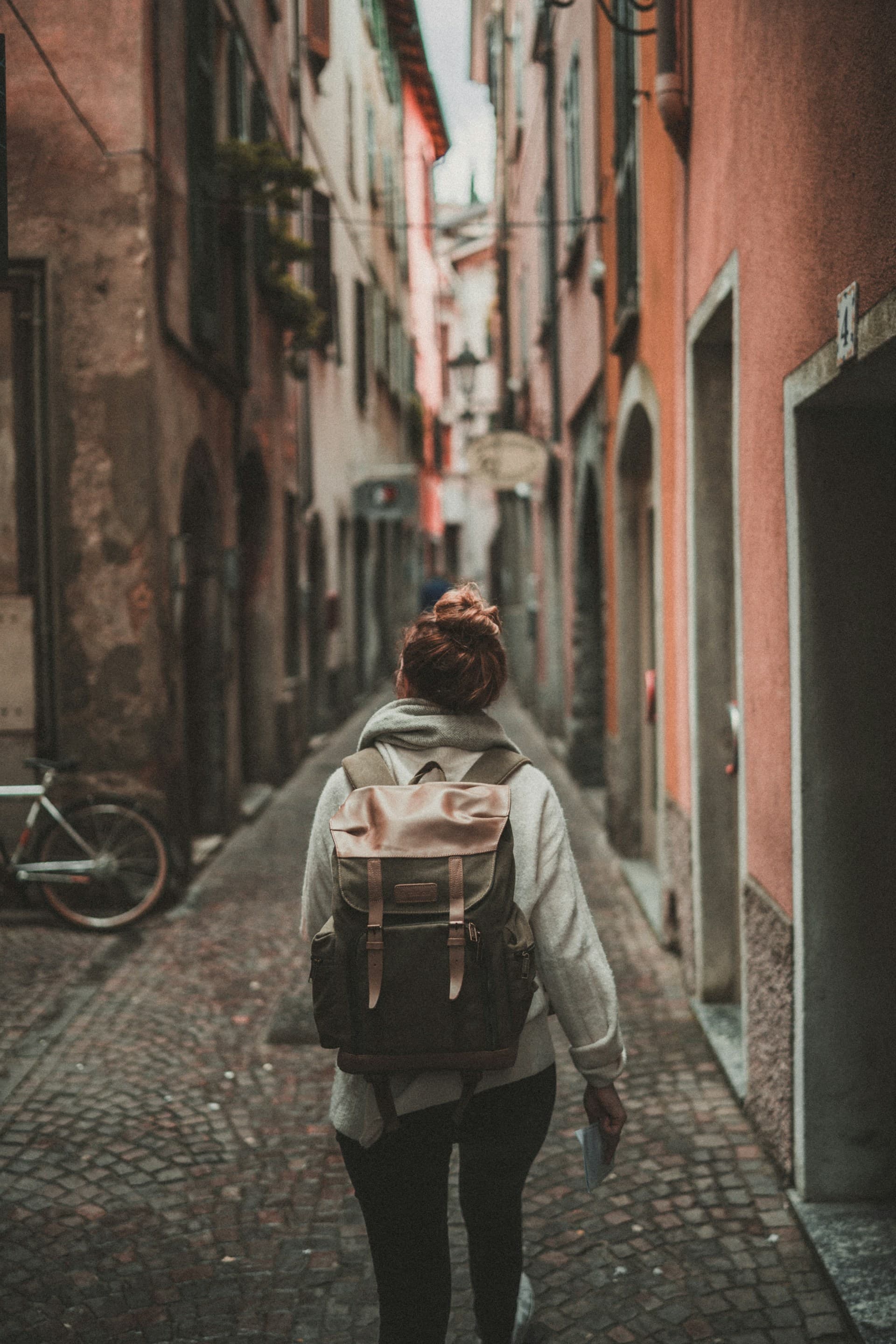
- Walk with purpose. Even if you are lost, walk as if you know where you are going. Stop in a shop or cafe to check your map rather than standing on a sidewalk.
- Stay on well-lit, populated streets at night. If a shortcut takes you through a dark alley or an empty area, take the longer, busier route.
- Wear a crossbody bag with the bag in front of your body, not behind. This makes it harder to snatch and easier for you to protect.
- Avoid wearing visible expensive jewelry or watches in areas with high rates of petty theft.
- If you feel followed, change your route. Cross the street. Enter a shop. Walk into a restaurant or hotel lobby. If the person follows you across multiple changes, go directly to the nearest public place with staff and ask for help.
Cultural Awareness and Dress
Understanding local cultural norms is practical, not about submission. When you understand the culture, you navigate it more effectively and receive more positive interactions.
Dress Codes by Region
- Middle East and North Africa (Morocco, Egypt, Jordan, UAE, Iran): Cover shoulders and knees as a baseline. In more conservative areas, loose-fitting clothing that does not reveal your silhouette is advisable. A scarf for your head is necessary for mosques and often useful in general for reducing unwanted attention.
- South Asia (India, Nepal, Sri Lanka, Pakistan): Shoulders and knees covered. Loose-fitting clothing is standard. A scarf or shawl is useful and culturally appropriate. In tourist areas of Goa, Rajasthan, or Kerala, dress codes are more relaxed.
- Southeast Asia (Thailand, Vietnam, Cambodia, Myanmar): Generally relaxed, but cover shoulders and knees when visiting temples. In Myanmar, this is strictly enforced. Remove shoes before entering any temple.
- East Asia (Japan, South Korea, China): No strict dress codes for tourists, but modest dress is culturally appreciated. Revealing clothing draws stares more than danger.
- Latin America: Varies widely by country and city vs. rural areas. Generally relaxed in cities, more conservative in rural and indigenous communities.
- Europe: No significant dress code concerns outside of religious sites (churches, mosques, synagogues), where shoulders and knees should be covered.
A Note on Dress and Responsibility
Dressing modestly in certain cultures is a practical strategy for reducing unwanted attention. It is not an admission that women are responsible for other people's behavior. You can dress however you want and you are never responsible for someone else's inappropriate actions. But clothing is a tool, and understanding how it is perceived in different cultures is part of traveling intelligently.
Dealing With Unwanted Attention
Unwanted attention — staring, catcalling, persistent approaches, and harassment — is a reality in many parts of the world. It is also a reality at home. Travel does not fundamentally change the nature of the problem; it changes the context.
Strategies That Work
- A confident, firm "no" or "leave me alone" in any language is universally understood. Do not smile while saying it. Do not soften it. Do not apologize. A firm refusal is more effective than a polite dodge.
- The "angry local woman" technique: Observe how local women handle harassment. In many cultures, an aggressive, loud refusal shames the harasser in front of others and ends the interaction immediately.
- Ignore and walk away. For catcalling and non-threatening comments, ignoring and continuing to walk is often the most effective response. Engagement, even negative engagement, encourages continuation.
- The fictional husband or boyfriend. "My husband is meeting me" or "my boyfriend is in that shop" is a tactical lie that works in many cultures where men respect another man's "claim" more than a woman's refusal. It is frustrating that this works, but it does.
- Move to a populated area. If someone is following you or making you uncomfortable, go where other people are. Enter a shop and tell the staff you are being followed. Sit next to a group of women or a family.
- Make a scene if necessary. If someone grabs you, touches you, or will not leave you alone despite clear refusals, raising your voice and drawing attention to the situation is appropriate. Most bystanders will intervene or at minimum the harasser will be embarrassed into leaving.
When to Report
- If you are physically grabbed, assaulted, or threatened, report it to local police and your embassy. Get a police report number for your insurance claim if applicable.
- Document the incident: note the time, location, description of the person, and any witnesses.
- Contact your embassy if you do not feel the local police are taking you seriously. Embassy staff can advocate on your behalf and connect you with resources.
Digital Safety While Traveling
- Use a VPN on public Wi-Fi (hotel, cafe, airport). Public networks are easy to monitor. A VPN encrypts your connection. ExpressVPN and NordVPN are reliable choices.
- Do not post your exact location in real time on social media. Share photos and locations after you have left. "I was at this beautiful temple today" is safer than "I am at this temple right now."
- Turn off Bluetooth and AirDrop in crowded areas. These can be used to send unwanted content or, in rare cases, to track your device.
- Use a privacy screen protector on your phone. It prevents people sitting next to you from reading your messages, seeing your maps, or noting your accommodation address.
- Be cautious with dating apps abroad. If you meet someone from a dating app, meet in a public place, tell someone where you are going, and share your live location. The same rules apply as at home — they are just more important when you do not have a local support network.
Region-Specific Tips
South and Southeast Asia
- Motorcycle taxis and tuk-tuks: Agree on the price before getting in. Use Grab or Bolt when available for transparent pricing.
- Food and water safety: Drink bottled or filtered water. Eat at busy stalls where food turnover is high.
- Temple etiquette: Always remove shoes. Cover your shoulders and knees. In Buddhist temples, never point your feet at a Buddha image.
- Scams to watch for: Gem scams (someone claims a temple is closed and offers to take you to a "special" gem shop), taxi meter refusals, and the "it is a holiday" trick to redirect you to specific shops.
Middle East and North Africa
- Male attention is more persistent than in many other regions. A firm, unsmiling refusal works. Sunglasses help avoid eye contact, which is sometimes interpreted as invitation.
- Dress conservatively outside tourist resorts. This genuinely reduces attention by 80 to 90 percent.
- Female-only spaces exist in many public areas: women's sections in restaurants, women's prayer areas in mosques, women-only beach hours. Use them if comfortable.
- Most interactions are genuinely hospitable. Offers of tea, food, or directions are usually genuine kindness, not threats. Learn to distinguish between hospitality and pressure.
Latin America
- Petty theft is more common than violent crime in most tourist areas. Protect your phone and bag; do not flash expensive items.
- Use Uber or registered taxis in cities like Mexico City, Bogota, Lima, and Sao Paulo. Hailing street taxis can be risky in certain areas.
- Solo women are a common sight in most Latin American countries. You will not stand out as unusual.
- Learn basic Spanish or Portuguese. Even rudimentary language skills dramatically improve your ability to navigate and connect with locals.
Europe
- Pickpocketing is the primary safety concern in major European cities, particularly in tourist areas, on public transit, and in crowded markets. Keep your bag closed and in front of you.
- Solo female travel in Europe is extremely common and well-supported. Infrastructure, safety, and general awareness are high.
- Eastern Europe is generally as safe as Western Europe, despite lingering stereotypes. Cities like Prague, Budapest, Krakow, and Tallinn are popular solo travel destinations.
Trusting Your Gut
The most important safety tool you have is your intuition. If something feels wrong — a person, a place, a situation — trust that feeling and remove yourself. You do not need to rationalize it. You do not need to worry about being rude. Your safety is more important than a stranger's feelings.
Conversely, trust your gut when things feel right. The family that invites you to dinner is probably genuinely hospitable. The shopkeeper who walks you to your hotel is probably genuinely kind. The woman on the bus who starts chatting is probably genuinely curious. Most people you meet while traveling are good people who are interested in you as a visitor to their home.
The world is overwhelmingly full of kindness, generosity, and human connection. Solo travel as a woman is not an act of recklessness — it is an act of courage that millions of women undertake every year, returning home with stories, friendships, and a deeper understanding of themselves and the world.
Prepare well. Stay aware. Trust yourself. And go.
Topics

Written by
TripGenie Team
The TripGenie team is passionate about making travel planning effortless with AI. We combine travel expertise with cutting-edge technology to help you explore the world.
@tripgenieGet Travel Tips Delivered Weekly
Get our best travel tips, destination guides, and exclusive deals delivered straight to your inbox every week.
No spam, ever. Unsubscribe anytime.