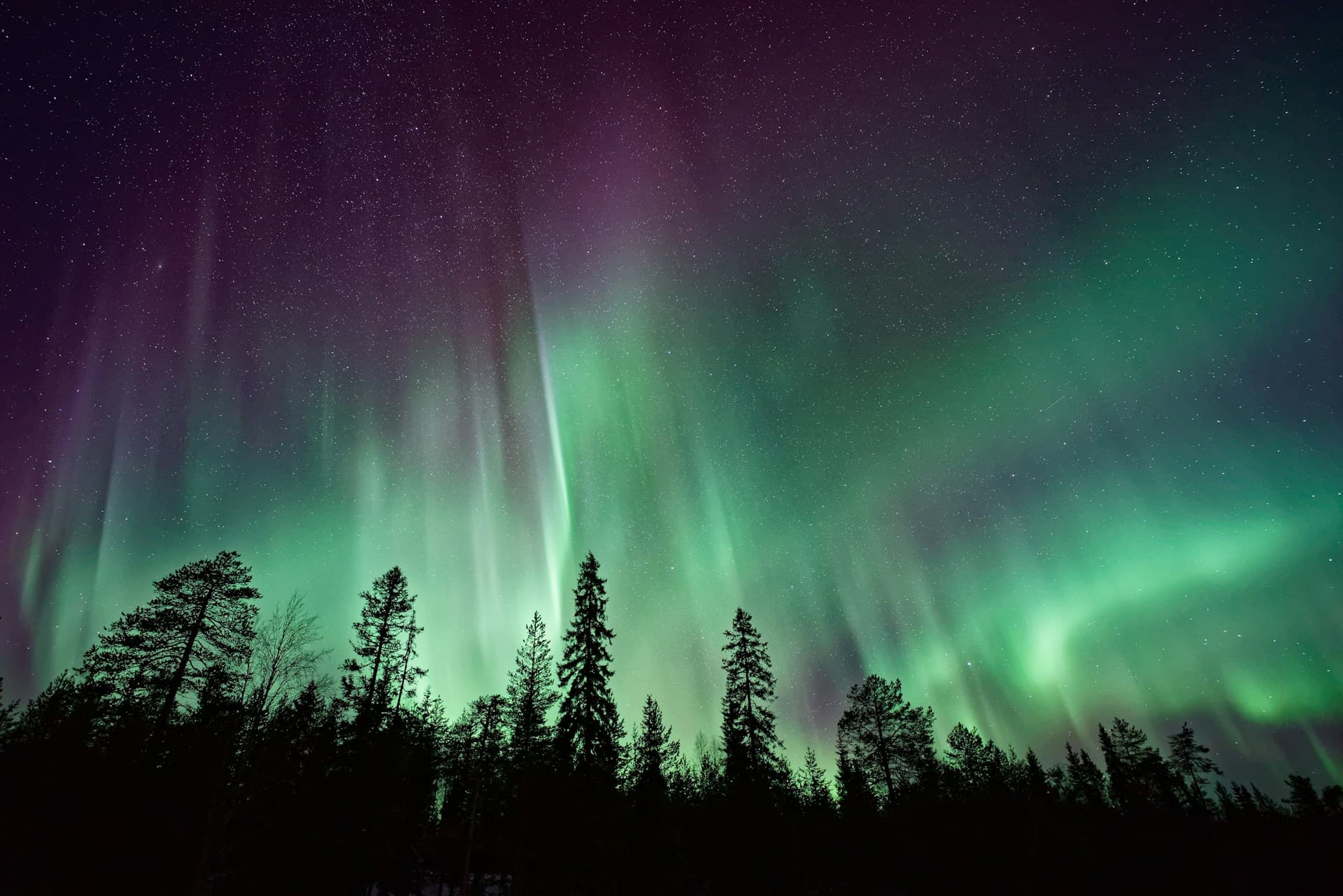

The northern lights, or aurora borealis, are one of the few natural phenomena that genuinely stop people in their tracks. Sheets of green, purple, and pink light ripple across the night sky in patterns that seem almost alive, and no amount of photography or video can fully convey the experience of standing beneath them. Seeing the aurora is not guaranteed on any given night, which makes planning both important and humbling. This guide covers the best places in the world to maximize your odds, the science behind the lights, and the practical details -- from camera settings to tour options -- that will help you capture the experience.
How the Northern Lights Work
The aurora borealis is caused by charged particles from the sun (the solar wind) colliding with gases in Earth's atmosphere. When these particles, guided by Earth's magnetic field toward the poles, strike oxygen and nitrogen molecules at altitudes of 100-300 km, the molecules emit light. Green is the most common color (produced by oxygen at lower altitudes), followed by purple and pink (nitrogen), and red (oxygen at higher altitudes).
The Solar Cycle
The sun follows an approximately 11-year cycle of activity, measured by the number of sunspots. More sunspots mean more solar flares and coronal mass ejections, which produce stronger and more frequent auroral displays.
2026 is an excellent year for northern lights viewing. The current solar cycle (Cycle 25) reached its maximum in 2024-2025, and activity remains elevated through 2026. During solar maximum years, aurora can be visible at lower latitudes than normal, and displays tend to be more vivid and dynamic.
What You Need for a Sighting
Three conditions must align:
- Solar activity: Measured by the Kp index (0-9). A Kp of 3+ means aurora is likely visible at high latitudes. A Kp of 5+ means a strong display. A Kp of 7+ is a major geomagnetic storm visible at mid-latitudes
- Clear skies: Clouds are the aurora hunter's primary enemy. A spectacular display happening behind an overcast sky is invisible
- Darkness: You need dark skies, which means no full moon, no city light pollution, and nighttime hours. In the Arctic, this limits the viewing season to roughly September through March
The 10 Best Places to See the Northern Lights
1. Tromso, Norway
Tromso sits at 69.6 degrees north, well within the auroral oval (the ring-shaped zone around the magnetic pole where aurora is most frequent). It is the most popular aurora destination in the world for good reason: excellent infrastructure, a vibrant city with restaurants and museums for cloudy nights, and some of the most reliable viewing conditions in the Arctic.
- Best months: September through March. November through January offers the darkest skies
- Viewing conditions: Coastal climate means variable weather. Guided tours drive to clear skies -- sometimes 100+ km from the city
- Tour options: Aurora chasing tours run nightly and cost 1,200-1,800 NOK ($110-170 USD). Top operators include Tromso Friluftsenter, Wandering Owl, and Arctic Expedition. Tours last 6-8 hours and include hot chocolate, warm clothing, and tripod-mounted photography assistance
- Self-drive alternative: Rent a car and drive to Kvaloya island or along the E8 highway toward the Finnish border for dark, open skies
- Other activities: Dog sledding, whale watching (November-January), the Arctic Cathedral, the Polar Museum
2. Iceland (Reykjavik and Beyond)
Iceland offers the unique combination of aurora viewing and otherworldly volcanic landscapes. The lights reflect in geothermal pools, frame glacier-capped mountains, and dance above black sand beaches.
- Best months: September through April
- Where to go: Reykjavik itself has too much light pollution. Drive at least 30 minutes outside the city. The Snaefellsnes Peninsula, Thingvellir National Park, and the Vik/South Coast area are excellent
- Tour options: From Reykjavik, bus tours cost 6,000-10,000 ISK ($43-72 USD). Self-driving is highly recommended for flexibility
- Weather challenge: Iceland's weather is extremely changeable. The Icelandic Met Office aurora forecast (en.vedur.is/weather/forecasts/aurora) shows both cloud cover and aurora probability -- the magic spot is where clear skies overlap with high aurora probability
- Bonus: If the aurora does not appear, Iceland's daytime attractions (Golden Circle, glaciers, waterfalls, geothermal areas) are world-class
3. Finnish Lapland (Rovaniemi, Inari, Saariselka)
Finnish Lapland has the most stable winter weather in the Nordic countries, with cold, dry continental air producing clear skies more consistently than coastal Norway or Iceland.
- Best months: September through March
- Key locations: Inari and Saariselka are further north and darker than Rovaniemi. Muonio and Kilpisjarvi near the Swedish border are also excellent
- Glass igloos: Finland pioneered the aurora glass igloo concept. Kakslauttanen Arctic Resort and Arctic SnowHotel & Glass Igloos in Sinetta offer heated glass-roof accommodation where you can watch the aurora from bed. Prices range from $300-600/night during peak season -- book 6-12 months ahead
- Aurora alerts: Many Finnish hotels and lodges offer wake-up calls when aurora appears. The Aurora Alert app sends push notifications based on real-time magnetometer data from Finnish observatories
- Activities: Snowmobile safaris, reindeer sleigh rides, ice fishing, visiting Santa Claus Village in Rovaniemi
4. Yellowknife, Canada
Yellowknife, the capital of Canada's Northwest Territories, sits directly beneath the auroral oval and has an extraordinary claim: aurora is visible on approximately 240 nights per year. The continental climate produces clear, cold winter skies with remarkable consistency.
- Best months: Mid-August through April. Peak viewing: December through March
- Viewing: The flat terrain and lack of mountains means 360-degree views. The famous Aurora Village offers heated teepees, guided photography, and traditional Indigenous cultural experiences. Three-night packages cost approximately $400-600 CAD ($290-440 USD)
- Temperature warning: January and February temperatures routinely drop to -30 to -40 degrees Celsius. Extreme cold-weather gear is essential -- many tour operators provide it
- Getting there: Fly from Edmonton or Calgary (2 hours). Accommodation in Yellowknife ranges from $100-250 CAD/night
5. Fairbanks, Alaska
Fairbanks sits at 64.8 degrees north with a subarctic continental climate that produces some of the clearest winter skies in North America. The University of Alaska Fairbanks runs the Geophysical Institute, which publishes one of the world's most respected aurora forecasts.
- Best months: September through March
- Viewing: Cleary Summit and Murphy Dome north of Fairbanks are popular viewing spots. The Chena Hot Springs Resort (60 miles northeast) offers aurora viewing from outdoor hot springs -- soaking in 106-degree water while aurora blazes overhead
- Tours: Guided tours from Fairbanks cost $100-200 USD per person. Some include Chena Hot Springs access
- Practical note: Unlike most aurora destinations, Fairbanks is reachable by road from the lower 48 states via the Alaska Highway -- a legendary road trip
- Self-drive: Rent a car with studded tires and head north of Fairbanks on the Steese or Elliott highways for dark skies
6. Lofoten Islands, Norway
The Lofoten archipelago combines dramatic mountain scenery, traditional red fishing cabins (rorbuer), and northern lights in a visual package that is almost unfairly photogenic.
- Best months: September through March
- Why Lofoten: The mountains and fjords provide foreground elements that elevate aurora photography from good to gallery-worthy. Aurora reflecting in still fjord water is a signature Lofoten image
- Where to stay: Reine, Hamnoy, and Svolvaer are the most popular bases. Traditional rorbuer cabins cost $100-250/night
- Weather: Similar to Tromso -- coastal and variable. The mountains can create micro-weather pockets of clear sky
- Self-drive: Highly recommended. The E10 highway connecting the islands provides constant access to beaches, bridges, and viewpoints
7. Swedish Lapland (Abisko, Kiruna, Jukkasjarvi)
Abisko, a tiny village on the shores of Lake Tornetrask in Sweden, has a microclimate phenomenon called the "blue hole of Abisko" -- a persistent clearing in the clouds created by the surrounding mountains. This gives Abisko some of the best aurora viewing statistics in the world.
- Best months: September through March
- Aurora Sky Station: Located at the top of a chairlift above Abisko, this viewing station at 900m altitude offers guided tours with aurora photography instruction. $95-130 USD per person
- Icehotel: In nearby Jukkasjarvi, the famous Icehotel offers aurora viewing alongside rooms made entirely of ice. Cold rooms (below freezing) start at $200/night; warm rooms with ice art at $350+/night
- Getting there: Fly to Kiruna, then bus or train to Abisko (1-1.5 hours)
8. Svalbard, Norway
Svalbard, an Arctic archipelago at 78 degrees north, offers aurora viewing during the polar night -- a period from mid-November to late January when the sun never rises. The perpetual darkness creates extraordinary viewing conditions.
- Best months: November through February (polar night provides 24-hour darkness)
- Base: Longyearbyen, the world's northernmost settlement with commercial flights
- Unique factor: Because of the extreme latitude, aurora appears overhead rather than on the northern horizon, creating a dome-like display
- Activities: Snowmobile excursions, dog sledding, ice cave exploration, visiting the Global Seed Vault
- Getting there: SAS and Norwegian fly from Oslo and Tromso to Longyearbyen
- Cost: Svalbard is expensive. Budget $200+ USD/day
9. Scottish Highlands (Caithness, Moray, Aberdeenshire)
Scotland is the most southerly destination on this list where aurora is regularly visible. During periods of high solar activity (like 2025-2026), the aurora can be spectacular from northern Scotland.
- Best months: October through March
- Where: The Caithness coast, Moray Firth, and Aberdeenshire coast offer dark skies and northern horizons. The Isle of Skye and the Outer Hebrides are also excellent
- Kp requirement: A Kp of 4-5 is typically needed for Scottish sightings, compared to Kp 2-3 for Arctic locations. During the current solar maximum, these levels are more frequent
- Why Scotland: You can combine aurora hunting with one of Europe's great road trips (the North Coast 500), whisky distillery visits, and castle exploration
- App: The AuroraWatch UK app and website provides real-time alerts for UK aurora visibility
10. Greenland (Kangerlussuaq, Ilulissat)
Greenland is the least-visited destination on this list and offers aurora viewing in near-total isolation. Kangerlussuaq, located at the head of a long fjord with a continental climate, has some of the clearest skies in the Arctic.
- Best months: September through April
- Kangerlussuaq: Clear skies approximately 300 days per year. The ice cap is a 30-minute drive from town -- standing on the Greenlandic ice sheet under northern lights is a once-in-a-lifetime experience
- Ilulissat: UNESCO-listed icefjord with massive icebergs. Aurora above icebergs is extraordinary
- Getting there: Air Greenland flies from Copenhagen and Reykjavik. Internal flights connect Kangerlussuaq and Ilulissat
- Cost: Greenland is one of the most expensive destinations in the world. Budget $250+ USD/day
Camera Settings for Northern Lights Photography
Getting a good aurora photograph requires manual camera control. Here are the settings that work:
DSLR or Mirrorless Camera
- Mode: Manual (M)
- Aperture: As wide as your lens allows (f/2.8 or wider is ideal, f/4 is workable)
- Shutter speed: Start at 8-15 seconds. Shorter for bright, fast-moving aurora; longer for faint displays
- ISO: Start at 1600-3200 and adjust based on brightness
- Focus: Manual focus set to infinity. Use live view to focus on a bright star, then tape the focus ring in place
- White balance: Set to approximately 3500-4000K (cooler than daylight) to preserve the natural green color
- Tripod: Absolutely essential. No handheld aurora photo will be sharp
- Remote shutter or 2-second timer: Eliminates camera shake from pressing the button
Smartphone
Modern smartphones (iPhone 15 Pro and later, Samsung Galaxy S23 and later, Google Pixel 7 and later) can capture aurora using night mode or astrophotography mode. Results will not match a dedicated camera, but they are surprisingly good for casual sharing. Use a phone tripod mount and a 10-second timer.
Tour vs. Self-Drive
| Factor | Guided Tour | Self-Drive |
|---|---|---|
| Cloud chasing | Driver knows where to go | You need to read weather maps |
| Cost | $100-200/person/night | Car rental + fuel ($50-80/day) |
| Photography help | Often included | You are on your own |
| Flexibility | Fixed schedule | Go whenever aurora appears |
| Warmth | Heated vehicle, hot drinks | You need your own supplies |
| Multi-night | Pay per night | Car rental covers all nights |
Recommendation: For a first-time viewer with 1-2 nights, take a guided tour. For a week-long aurora trip, rent a car for maximum flexibility.
How to Maximize Your Probability
- Stay 3+ nights: Each night gives you roughly a 50-70% chance of aurora at high-latitude locations during peak season. Over 3 nights, your cumulative probability exceeds 85%
- Monitor forecasts: Check the NOAA Space Weather Prediction Center (swpc.noaa.gov) for the 3-day aurora forecast and the Kp index. The My Aurora Forecast app provides real-time data and notifications
- Be willing to move: If your location is cloudy, drive to where it is clear. A 100 km drive can make the difference between overcast and clear
- Stay up late: Aurora can appear at any time during dark hours, but statistically peaks between 10:00 PM and 2:00 AM local magnetic midnight
- Watch for coronal mass ejections (CMEs): When a CME is detected heading toward Earth, aurora forecasts spike 2-3 days later. This gives you a short window to book last-minute travel if you live within striking distance of a viewing location
Plan Your Northern Lights Trip with TripGenie
An aurora trip involves coordinating dark-sky timing, weather patterns, accommodation in remote Arctic locations, and often multi-destination logistics. TripGenie can help you build an itinerary that combines aurora viewing nights with daytime activities, realistic travel times between locations, and backup plans for cloudy nights -- so you make the most of every hour in the Arctic.
Final Thoughts
The northern lights are one of those experiences that genuinely changes the way you think about the natural world. Standing in silence on a frozen lake while green light pulses overhead has a quality that is difficult to articulate -- it feels ancient, humbling, and profoundly alive. Plan carefully, stay patient on cloudy nights, and when the aurora finally appears, put the camera down for at least a few minutes and just look up.
Topics

Written by
TripGenie Team
The TripGenie team is passionate about making travel planning effortless with AI. We combine travel expertise with cutting-edge technology to help you explore the world.
@tripgenieGet Travel Tips Delivered Weekly
Get our best travel tips, destination guides, and exclusive deals delivered straight to your inbox every week.
No spam, ever. Unsubscribe anytime.