
European Christmas markets are one of the continent's great seasonal traditions -- a reason to brave the cold, wrap your hands around a mug of mulled wine, and wander through lamplit wooden stalls selling handcrafted ornaments, roasted chestnuts, and gingerbread. The tradition originated in the German-speaking world in the late Middle Ages, and while Germany still dominates the Christmas market landscape, the tradition has spread across the continent. This guide covers 20 of the best markets in 12 countries, with the practical details you need to plan a winter trip.
When Do Christmas Markets Open?
Most European Christmas markets follow a similar schedule:
- Opening: Last week of November (often the Friday before Advent, which begins on the fourth Sunday before Christmas)
- Closing: December 23 or December 24. A few extend to December 30 or January 6
- Hours: Typically 11:00 AM to 9:00 PM on weekdays, with extended hours on Fridays and Saturdays
- Peak crowds: The first two weekends of December and the weekend before Christmas are the busiest
For 2026: Advent begins on November 29, so most markets will open between November 20 and November 28.
The 20 Best Christmas Markets in Europe
Germany
#### 1. Nuremberg Christkindlesmarkt
The most famous Christmas market in the world. Held in the Hauptmarkt (main square) since 1628, Nuremberg's market features around 180 wooden stalls with strict quality standards -- everything sold must be handcrafted.
- Dates: Typically late November to December 24
- Signature items: Nuremberg Lebkuchen (spiced gingerbread), Zwetschgenmannle (prune figurines), gold foil angel ornaments
- Signature drink: Gluhwein (mulled wine) in a collectible mug -- 3-4 EUR plus a 2-3 EUR mug deposit
- Must-see: The opening ceremony where the Christkind (a golden-clad figure representing the Christ child) delivers a prologue from the church balcony
- Accommodation: Hotels fill early. Budget $80-150/night for mid-range. The Hotel Drei Raben is a popular choice at $120-180/night
- Getting there: Direct trains from Munich (1 hour), Frankfurt (2 hours), or Berlin (3.5 hours)
#### 2. Dresden Striezelmarkt
Germany's oldest Christmas market, dating to 1434. The Striezelmarkt sits in the Altmarkt and is known for its enormous Christmas pyramid, towering Christmas tree, and the world's largest free-standing Christmas arch.
- Dates: Late November to December 24
- Signature items: Dresdner Stollen (a dense fruit cake dusted with powdered sugar), Pulsnitzer Pfefferkuchen (gingerbread), handmade Erzgebirge wooden figurines (nutcrackers, smokers, arches)
- Stollen festival: Usually held on the second Saturday of Advent. A massive Stollen cake weighing several tons is paraded through the city and distributed to the crowd
- Nearby markets: Dresden has over a dozen markets. The Medieval Christmas Market at the Stallhof courtyard serves mead and period foods
#### 3. Stuttgart Christmas Market
One of the largest and oldest in Europe, with over 280 stalls filling Schlossplatz and surrounding squares. Stuttgart is known for the ornate, competition-winning decorations on each stall's roof.
- Dates: Late November to December 23
- Signature items: Swabian Maultaschen (stuffed pasta), Swabian Christmas ornaments, blown glass decorations
- Best feature: The Finnish Christmas Market in the Karlsplatz, which sells Nordic goods and serves salmon dishes
#### 4. Cologne Christmas Markets
Cologne has seven distinct markets scattered across the city center. Each has its own character.
- Cathedral Market (Dom): The most famous, set against the backdrop of the massive Cologne Cathedral. Over 150 stalls and a striking stage program
- Alter Markt: Traditional market with a focus on local crafts
- Heumarkt: Home to an ice rink and family activities
- Neumarkt: The "Market of Angels" -- a more refined, less commercial atmosphere
- Stadtgarten: A smaller, quieter alternative in a park setting
- Signature drink: Kolsch beer (Cologne's local style) alongside the standard Gluhwein
- Getting there: Cologne is a major rail hub with excellent connections to Amsterdam (2.5 hours), Brussels (2 hours), and Paris (3.5 hours via Thalys)
#### 5. Munich Christkindlmarkt
Held in the Marienplatz beneath the neo-Gothic town hall, Munich's main market benefits from one of the most dramatic backdrops of any market in Europe.
- Dates: Late November to December 24
- Signature items: Bavarian ornaments, hand-carved nativity figures, Lebkuchen hearts
- Nearby: The Tollwood Winter Festival at the Theresienwiese (Oktoberfest grounds) is a parallel event with organic food, live music, and art installations -- more bohemian than the traditional market
Austria
#### 6. Vienna Christmas Markets
Vienna hosts over 20 Christmas markets. The Rathausplatz market in front of City Hall is the largest, with ice skating, a children's area, and a tunnel of lights.
- Dates: Mid-November to December 26 (some extend into January)
- Signature items: Punsch (Austrian punch, stronger and more varied than German Gluhwein), Maroni (roasted chestnuts), Kartoffelpuffer (potato pancakes)
- Best market for atmosphere: Spittelberg -- a charming neighborhood market in narrow cobblestoned streets with independent artisan stalls
- Best market for tradition: Am Hof and Freyung markets focus on high-quality handcrafts
- Accommodation: Vienna hotels range from $60/night (budget) to $200+/night (luxury). The 25hours Hotel near the MuseumsQuartier is well-located at $100-150/night
#### 7. Salzburg Christkindlmarkt
Set in the Residenzplatz and Domplatz against the backdrop of the Hohensalzburg Fortress, Salzburg's market has been running since the late 15th century.
- Dates: Mid-November to December 26
- Signature items: Salzburger Nockerln (sweet souffle), Mozart Kugeln (chocolate balls), handmade candles
- Unique: The Krampuslauf -- a parade of terrifying horned figures (Krampus, the anti-St. Nicholas) running through the streets. Usually held on December 5. Not for young children
France
#### 8. Strasbourg Christkindelsmärik
Strasbourg bills itself as the "Capital of Christmas" and has been hosting a market since 1570, making it one of the oldest in Europe. The Alsatian city's Franco-German heritage gives its market a unique cultural blend.
- Dates: Late November to December 24
- Locations: Markets spread across multiple squares, including Place Broglie, Place de la Cathedrale, and Place Kleber (home to the enormous "Great Christmas Tree")
- Signature items: Bredele (Alsatian Christmas cookies in dozens of varieties), foie gras, vin chaud (mulled wine), Alsatian pottery
- Must-see: The cathedral illumination show (free, nightly)
- Getting there: TGV from Paris Gare de l'Est (1 hour 45 minutes). Also well-connected to Basel (1.5 hours) and Frankfurt (2 hours)
#### 9. Colmar Christmas Market
If Strasbourg is the Capital of Christmas, Colmar is its fairy-tale little sister. The half-timbered houses of the old town, particularly the Petite Venise (Little Venice) canal district, are illuminated with thousands of lights.
- Dates: Late November to December 29
- Markets: Five distinct markets across the old town, each with a theme (children, artisans, gastronomy, etc.)
- Signature items: Alsatian wine (especially Gewurztraminer), Kugelhopf (ring-shaped cake), handmade textiles
- Best feature: Walking through the illuminated streets at dusk, when the lights reflect in the canal water
Czech Republic
#### 10. Prague Christmas Markets
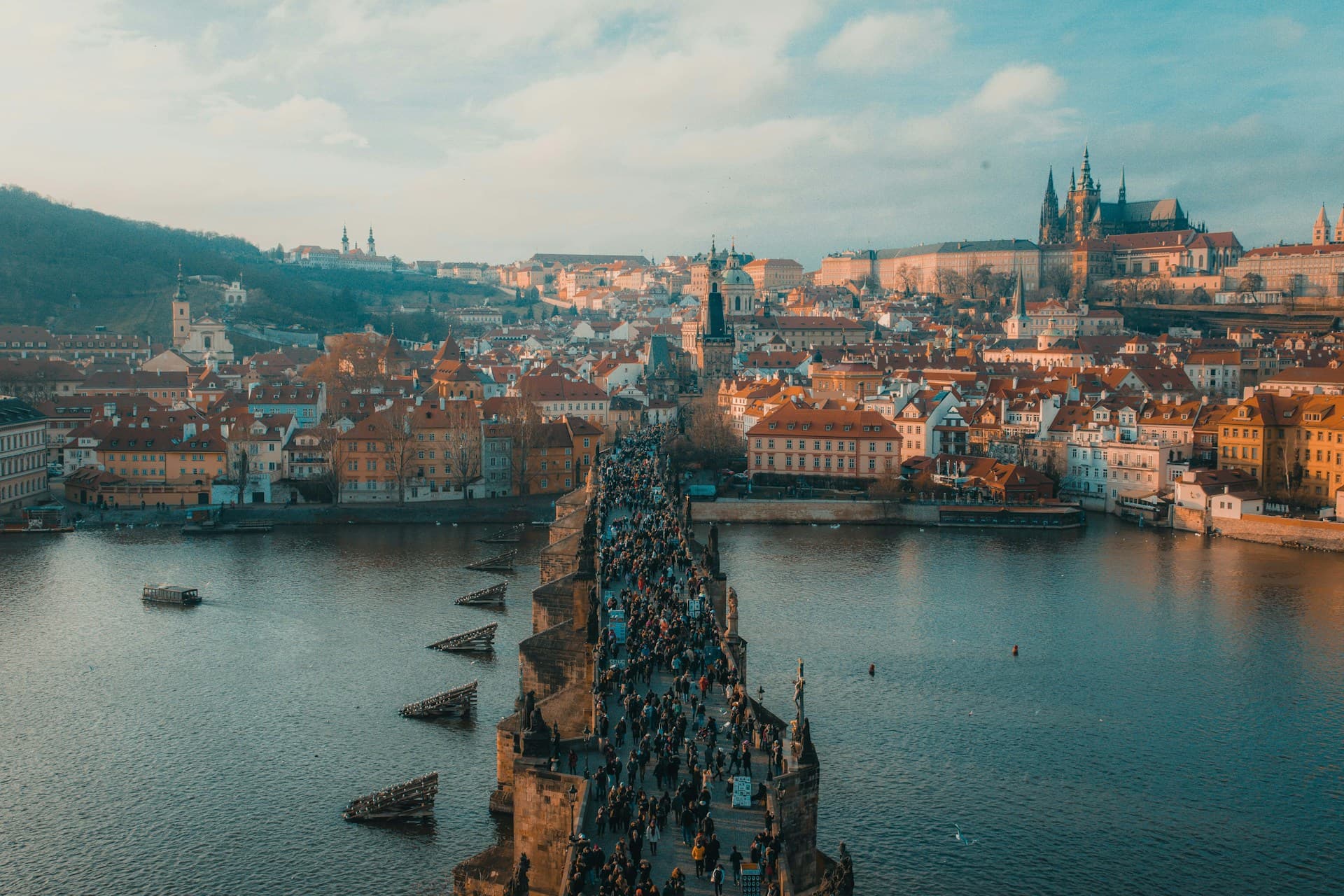
Prague's Christmas markets fill the Old Town Square and Wenceslas Square with an extraordinary backdrop -- the Gothic Tyn Church, the Astronomical Clock, and the Baroque architecture of the old town.
- Dates: Late November to January 6
- Signature items: Trdelnik (chimney cake), Czech crystal ornaments, svarak (Czech mulled wine), klobasa (grilled sausage)
- Prices: Prague remains significantly cheaper than Western Europe. A Gluhwein is about 60-80 CZK ($2.50-3.40 USD), a trdelnik is 80-120 CZK ($3.40-5.00 USD)
- Accommodation: Central hotels from $50-80/night mid-range, making Prague one of the best-value Christmas market destinations
Switzerland
#### 11. Basel Christmas Market
Switzerland's largest Christmas market stretches across the Barfusserplatz and Munsterplatz. The latter, set against the red sandstone cathedral, is particularly atmospheric.
- Dates: Late November to December 23
- Signature items: Swiss chocolate, Raclette, Basler Lackerli (gingerbread biscuit), hand-blown glass ornaments
- Cost warning: Switzerland is expensive. A Gluhwein in Basel costs 6-8 CHF ($6.80-9.00 USD), roughly double what you would pay in Germany or Austria
#### 12. Zurich Christkindlimarkt
The Hauptbahnhof (main train station) hosts one of Europe's largest indoor Christmas markets, with a Swarovski crystal Christmas tree as its centerpiece. The Niederdorf old town has a second, outdoor market.
- Dates: Late November to December 24
- Unique: The Singing Christmas Tree -- a tiered structure where choir groups perform daily
Belgium
#### 13. Brussels Winter Wonders (Plaisirs d'Hiver)
Brussels transforms the area around the Grand Place and Place Sainte-Catherine into a winter wonderland with over 200 stalls, a Ferris wheel, a light show on the Grand Place facade, and an ice rink.
- Dates: Late November to early January
- Signature items: Belgian hot chocolate (the real thing, made with melted chocolate), waffles (both Brussels-style and Liege-style), jenever (Belgian gin)
- Grand Place light show: Free sound-and-light show projected onto the ornate guild houses, running every 30 minutes in the evening
- Getting there: Central location with Eurostar from London (2 hours), Thalys from Paris (1.5 hours), ICE from Cologne (2 hours)
#### 14. Bruges Christmas Market
Bruges is already one of the most atmospheric small cities in Europe. Add Christmas lights, a market in the Markt square, and an ice rink at the Minnewater lake, and the effect is extraordinary.
- Dates: Late November to early January
- Signature items: Bruges chocolate, speculoos (spiced cookies), hot chocolate, jenever
- Accommodation: Bruges is small and books up quickly. Budget $80-150/night for a central hotel
Scandinavia
#### 15. Copenhagen Tivoli Gardens Christmas Market
Tivoli Gardens, Copenhagen's 19th-century amusement park, transforms for Christmas with over 60 stalls, thousands of lights, and functioning rides.
- Dates: Mid-November to December 31
- Entry: Tivoli entrance fee is 140 DKK ($20 USD) for adults
- Signature items: Glogg (Scandinavian mulled wine), aebleskiver (round pancake puffs), Danish Christmas decorations
- Unique: The combination of Christmas market, amusement park rides, and Tivoli's legendary atmosphere creates something distinct from the German-style markets
#### 16. Stockholm Christmas Markets
Stockholm's main market is at Stortorget in Gamla Stan (Old Town), where the narrow medieval streets and colorful buildings create a compact, intimate setting.
- Dates: Late November to December 23
- Signature items: Pepparkakor (ginger snaps), Glogg, Swedish candle holders, hand-carved Dala horses
- Skansen: The open-air museum on Djurgarden has its own Christmas market with traditional Swedish crafts and food, set among historic buildings
Hungary
#### 17. Budapest Christmas Fair (Vorosmarty Square)
Budapest is one of Europe's best-value Christmas market destinations, combining beautiful architecture, affordable prices, and distinctive Hungarian food.
- Dates: Mid-November to January 1
- Location: Vorosmarty Square (main market) and St. Stephen's Basilica (second market with a light show on the basilica facade)
- Signature items: Chimney cake (kurtoskalacs), langos (fried dough), Hungarian sausage, goulash in a bread bowl, Hungarian wines (Egri Bikaver, Tokaji)
- Prices: A Gluhwein costs about 1,000-1,500 HUF ($2.70-4.00 USD), a langos about 1,500-2,500 HUF ($4.00-6.70 USD)
- Bonus: The thermal baths (Szechenyi, Gellert) are perfect for warming up after a cold market evening
Poland
#### 18. Krakow Christmas Market
Krakow's market fills the enormous Rynek Glowny (Main Market Square), the largest medieval town square in Europe, with stalls, a nativity scene, and live performances.
- Dates: Late November to January 1
- Signature items: Oscypek (smoked sheep cheese, grilled and served with cranberry sauce), pierogi, grzaniec (Polish mulled wine), hand-painted glass ornaments
- Prices: Extremely affordable. A mug of grzaniec costs about 10-15 PLN ($2.50-3.75 USD)
- Nativity scene tradition: Krakow has a UNESCO-recognized tradition of building elaborate portable nativity scenes (szopki). A contest is held in the first week of December in the Main Square
Estonia
#### 19. Tallinn Christmas Market
Tallinn's market in the Town Hall Square of the medieval old town claims to be the site of the first public Christmas tree in Europe (1441). The Gothic architecture creates a fairy-tale setting.
- Dates: Mid-November to early January
- Signature items: Estonian marzipan, blood sausage, mulled wine, woolen knitwear
- Prices: Very affordable by Northern European standards
- Getting there: Ferry from Helsinki (2 hours, $20-40 EUR one-way on Tallink or Viking Line), making Tallinn an easy day-trip or weekend extension from Finland
Italy
#### 20. Bolzano Christmas Market (South Tyrol)
Bolzano, in Italy's German-speaking South Tyrol region, hosts the largest Christmas market in Italy. It has the look and feel of an Austrian market but with Italian food quality.
- Dates: Late November to January 6
- Location: Piazza Walther in the historic center
- Signature items: Strudel, speck (cured ham), South Tyrolean wines, hand-carved wooden figurines from the Val Gardena
- Unique: The blend of Italian and Austrian culture creates a food experience unmatched by any other market -- Gluhwein alongside espresso, bratwurst alongside fresh pasta
Multi-City Christmas Market Routes
The Rhine Route (5-7 days)
Cologne (2 days) -- Strasbourg (2 days) -- Basel (1 day) -- Zurich (1 day)
All connected by fast, frequent trains. Total rail time: approximately 6 hours across all legs.
The Central European Route (7-10 days)
Prague (2 days) -- Vienna (2 days) -- Salzburg (1 day) -- Munich (2 days) -- Nuremberg (1 day)
Rail connections are excellent. Consider a Eurail Pass for flexibility.
The Budget Route (5-7 days)
Budapest (2 days) -- Krakow (2 days) -- Prague (2 days)
The three most affordable Christmas market cities in Central Europe. Flights between Budapest and Krakow are $20-40 on Wizz Air or Ryanair.
The Nordic Route (5-7 days)
Copenhagen (2 days) -- Stockholm (2 days) -- Tallinn (2 days) -- Helsinki (1 day)
The Copenhagen-Stockholm train takes 5 hours. Stockholm to Tallinn via Helsinki involves a ferry.
What to Buy at Christmas Markets
- Handmade ornaments: Glass baubles from Lauscha (Germany), painted wooden ornaments from the Erzgebirge, straw stars from Scandinavia
- Nutcrackers and smokers: Traditional Erzgebirge wooden figures from German markets. Authentic ones are not cheap ($30-100+) but are heirloom quality
- Candles: Beeswax candles from Austrian and German markets
- Food gifts: Lebkuchen, Stollen, Alsatian cookies (bredele), marzipan, and spiced nuts all travel well
- Ceramics: Alsatian pottery from Strasbourg/Colmar, Hungarian pottery from Budapest
- Textiles: Woolen scarves, mittens, and hats from Scandinavian and Baltic markets
Tip: The best-quality items are found at markets with strict vendor standards (Nuremberg, Strasbourg, Salzburg). Larger markets sometimes include mass-produced imports -- look for stalls advertising "handmade" or "local artisan" products.
Beating the Crowds
- Visit on weekday afternoons: Tuesday through Thursday between 2:00 and 5:00 PM is the quietest window
- Go in late November: The first week after opening is significantly less crowded than December
- Visit smaller cities: Colmar, Tallinn, Bruges, and Bolzano have outstanding markets without the crushing weekend crowds of Nuremberg, Strasbourg, or Vienna
- Morning hours: Markets open at 10:00 or 11:00 AM. The first hour is calm at most locations
Accommodation Tips
- Book 2-3 months ahead for popular cities during December, especially for weekends
- Consider apartment rentals: Platforms like Booking.com and Airbnb often offer better value than hotels for groups or longer stays
- Stay near a transit hub: You do not need to be next to the market. A hotel near a metro or tram stop keeps costs down and lets you explore wider
Plan Your Christmas Market Route with TripGenie
A multi-city Christmas market trip involves coordinating train schedules, market opening dates, hotel availability during peak season, and budget management across multiple currencies. TripGenie can help you map out a route that maximizes market time while keeping travel days efficient and costs transparent.
Final Thoughts
There is something irreplaceable about standing in a European square in December, the air cold enough to see your breath, with a warm mug in your hand and wooden stalls glowing around you. Christmas markets are not just shopping -- they are a cultural experience rooted in centuries of tradition, and they remain one of the best reasons to visit Europe in winter. Pick your route, pack your warmest coat, and go.
Topics

Written by
TripGenie Team
The TripGenie team is passionate about making travel planning effortless with AI. We combine travel expertise with cutting-edge technology to help you explore the world.
@tripgenieGet Travel Tips Delivered Weekly
Get our best travel tips, destination guides, and exclusive deals delivered straight to your inbox every week.
No spam, ever. Unsubscribe anytime.