
Why Vietnam Belongs on Every Traveler's List
Vietnam is one of those countries that permanently recalibrates your understanding of what travel can be. The food is staggeringly good at every price point. The landscapes range from misty mountain passes to emerald rice terraces to white-sand tropical islands. The history is layered and complex. And the Vietnamese people bring an energy and warmth to their hospitality that makes you feel simultaneously challenged and deeply welcomed.
It is also, frankly, one of the best-value destinations on Earth. A bowl of pho from a street-side stall -- the same kind of pho that has made the dish world-famous -- costs less than two dollars. A night in a clean, air-conditioned hotel with Wi-Fi costs fifteen to twenty dollars in many cities. A first-class sleeper train from Hanoi to Hue costs thirty-five dollars.
But Vietnam is not always easy. The traffic is chaotic and intimidating. Scams targeting tourists exist. The climate varies dramatically from north to south. And the sheer number of things to see and do can make planning overwhelming for first-timers.
This guide solves that problem. It covers everything you need to know to plan and execute a Vietnam trip with confidence.
Visa and Entry Requirements
E-Visa (The Easiest Option)
Vietnam offers an electronic visa (e-visa) for citizens of most countries. This is the recommended option for the majority of travelers.
- Duration: Single entry, valid for up to 90 days
- Cost: $25 USD (paid online)
- Processing Time: 3-5 business days
- Application: Apply through the official Vietnamese immigration portal at evisa.xuatnhapcanh.gov.vn. Use only the official government website -- numerous third-party sites charge unnecessary fees.
- Photo Requirements: 4x6 cm photo with white background, uploaded during the application
Visa-Free Entry
Citizens of certain countries (including many ASEAN nations, plus select others) can enter Vietnam without a visa for periods ranging from 14 to 45 days. Check Vietnam's current visa exemption list for your nationality.
Important Notes
- Your passport must be valid for at least 6 months beyond your planned entry date
- Print your e-visa approval letter -- you will need it at immigration
- Arrival airports for e-visa: All major international airports including Hanoi (Noi Bai), Ho Chi Minh City (Tan Son Nhat), Da Nang, Nha Trang (Cam Ranh), and Phu Quoc
Understanding Vietnam's Geography and Climate
Vietnam is shaped like a stretched-out S, running over 1,650 kilometers from north to south. This extreme length means the climate varies dramatically.
Northern Vietnam (Hanoi, Ha Long Bay, Sapa)
- Cool Season (October-March): Temperatures of 10-20 degrees Celsius. January and February can be cold, foggy, and drizzly, especially in the mountains. Sapa can drop to near freezing. Pack layers.
- Hot Season (April-September): Temperatures of 28-38 degrees Celsius with high humidity. Summer rains, especially July-August.
- Best Time: October-November (cool, dry, clear skies) or March-April (warming, spring blooms)
Central Vietnam (Hue, Hoi An, Da Nang)
- Dry Season (February-August): Warm to hot, sunny, excellent beach weather
- Wet Season (September-January): The central coast gets its heaviest rain from October-December, sometimes including typhoons. Hoi An floods regularly in October and November -- check conditions before booking.
- Best Time: February-May (warm, dry, not yet scorching)
Southern Vietnam (Ho Chi Minh City, Mekong Delta, Phu Quoc)
- Dry Season (December-April): Hot, sunny, 30-35 degrees Celsius. The most comfortable months.
- Wet Season (May-November): Daily afternoon downpours (usually 1-2 hours), but mornings are often clear. Still very warm. Phu Quoc gets heavy rain June-September.
- Best Time: December-March (dry, warm, comfortable humidity)
The Universal Best Window
If you are doing a north-to-south trip, March through May offers the best compromise -- warming weather in the north, dry and sunny in the center, and hot but not yet peak monsoon in the south.
The Must-Visit Destinations
Hanoi
Vietnam's capital is a sensory overload in the best possible way. The Old Quarter's 36 streets (each traditionally dedicated to a specific trade) are a maze of motorbikes, street food stalls, French colonial architecture, and Vietnamese temples.
Must-Do in Hanoi:
- Old Quarter Walking Tour: Wander Hang Be (bamboo), Hang Gai (silk), and Hang Bac (silver) streets. Start early morning when the streets are quietest.
- Hoan Kiem Lake: The spiritual center of Hanoi. Walk the red bridge to Ngoc Son Temple on the island. Free to walk around the lake; temple entry 30,000 VND ($1.20 USD).
- Ho Chi Minh Mausoleum Complex: The preserved body of Ho Chi Minh, the Presidential Palace, and the One Pillar Pagoda. Free entry. Closed Mondays, Fridays, and usually all of October-November for maintenance. Dress conservatively, no shorts or tank tops.
- Temple of Literature: Vietnam's first university, founded in 1070. Beautiful example of traditional Vietnamese architecture. Entry 30,000 VND ($1.20 USD).
- Train Street: A narrow lane in the Old Quarter where a functioning railway runs between houses mere meters apart. Residents press against their walls as the train passes. Trains typically pass at set times (check locally, roughly 3:30 PM and 7:30 PM). Note: access has been restricted at times for safety -- check current status.
- Egg Coffee at Giang Cafe: Ca phe trung -- a Hanoi specialty of egg yolk whipped with condensed milk and coffee. Giang Cafe on Nguyen Huu Huan Street claims to have invented it. 35,000 VND ($1.40 USD).
- Street Food Tour: Consider a guided street food tour for your first night. Hanoi Street Food Tours and Backstreet Academy run excellent walks ($25-35 per person, 3 hours, 8-10 food stops).
Days Needed: 2-3 days minimum.
Ha Long Bay
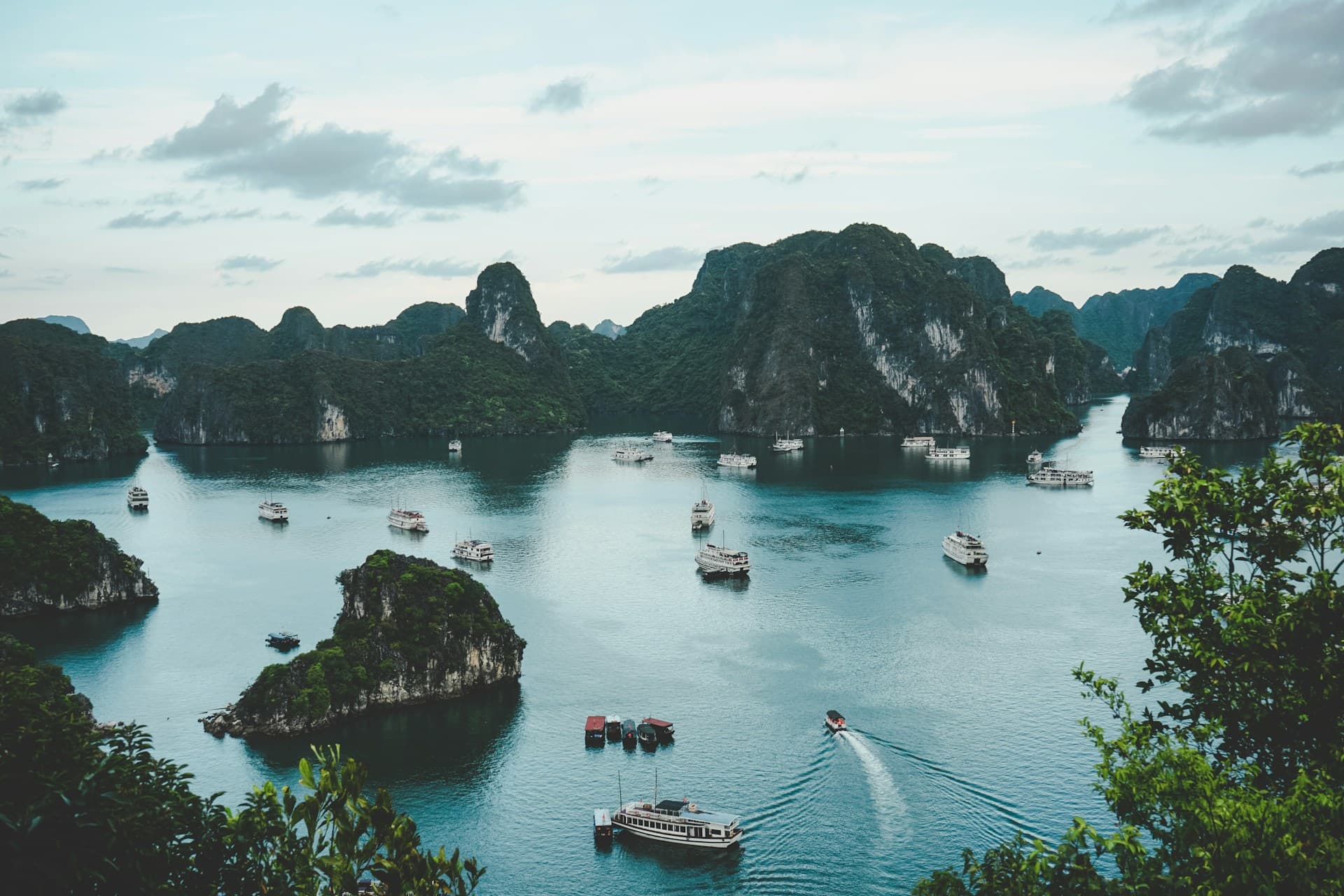
The iconic seascape of nearly 2,000 limestone karsts rising from emerald water. A UNESCO World Heritage Site and Vietnam's most famous natural attraction.
How to Visit:
- Overnight Cruise (Recommended): A 2-day/1-night cruise is the standard, with 3-day/2-night options for a more relaxed pace. The overnight allows you to see the bay at dawn, which is when it is most magical.
- Budget Cruises: $80-130 per person for 2 days/1 night. Basic but functional boats with shared meals and kayaking.
- Mid-Range Cruises: $150-250 per person. Better food, smaller groups, newer boats. Indochina Junk and Bhaya Cruises are reliable mid-range operators.
- Luxury Cruises: $300-500+ per person. Heritage Line, Paradise Luxury, and Orchid Cruises offer premium experiences with spacious cabins and gourmet dining.
- Day Trips: Available from Hanoi ($50-80, 12-hour day). Rushed and tiring but feasible if time is limited.
Lan Ha Bay Alternative: Adjacent to Ha Long Bay but far less crowded, Lan Ha Bay offers a similar karst landscape with better swimming and kayaking. Accessible from Cat Ba Island. Some cruise operators now include Lan Ha Bay in their itineraries.
Getting There: 2.5-3.5 hours by road from Hanoi. Most cruises include hotel pickup.
Sapa and the Northern Mountains
The rice terraces of Sapa are among the most photographed landscapes in Southeast Asia. The town sits at 1,500 meters in the Hoang Lien Son mountain range, near the Chinese border.
Key Experiences:
- Rice Terrace Trekking: Multi-day treks through Hmong and Dao minority villages, staying in homestays. The terraces are most spectacular when flooded (May-June) or just before harvest when they turn golden (September-October). A 2-day/1-night trek with a local guide and homestay costs $40-80 per person.
- Fansipan: Vietnam's highest peak (3,143 meters). A cable car (850,000 VND / $34 USD round trip) takes you near the summit, or you can trek (2 days with a guide, $80-120).
- Bac Ha Sunday Market: A vibrant weekly market where Flower Hmong and other ethnic groups trade goods. One of northern Vietnam's most authentic cultural experiences. Bac Ha is a 3-hour drive from Sapa.
Getting to Sapa: Overnight sleeper train from Hanoi to Lao Cai (8-9 hours, $20-35 for a 4-berth cabin), then a 1-hour bus to Sapa. Or a direct sleeper bus from Hanoi (5-6 hours, $15-25).
Hue
The former imperial capital of Vietnam (1802-1945), Hue is a city of palaces, tombs, pagodas, and some of the country's best food.
Must-Do in Hue:
- Imperial Citadel: A massive walled compound modeled after Beijing's Forbidden City. Much was destroyed during the 1968 Tet Offensive, but ongoing restoration has brought back significant sections. Entry 200,000 VND ($8 USD). Budget 2-3 hours.
- Royal Tombs: The tombs of the Nguyen Dynasty emperors are scattered along the Perfume River south of the city. The Tomb of Tu Duc and the Tomb of Khai Dinh are the most impressive. Entry 150,000 VND each ($6 USD). Hire a motorbike driver to visit several in a day ($15-20 for a full day).
- Thien Mu Pagoda: The seven-story octagonal pagoda on the Perfume River is Hue's most iconic landmark. Free entry. Accessible by dragon boat from the city center ($5-8 per person round trip).
- Bun Bo Hue: Hue's signature dish -- a spicy, lemongrass-infused beef noodle soup with pork knuckle, blood cake, and chili oil. Richer and more complex than pho. Available everywhere in Hue for 30,000-50,000 VND ($1.20-2 USD).
Days Needed: 2 days.
Hoi An
A beautifully preserved trading port town with lantern-lit streets, Japanese and Chinese merchant houses, and one of Vietnam's best food scenes. UNESCO World Heritage Site.
Must-Do in Hoi An:
- Old Town at Night: The ancient streets lit by hundreds of silk lanterns reflected in the Thu Bon River is one of Vietnam's most beautiful sights. Best experienced on the 14th day of each lunar month during the Full Moon Lantern Festival, when electric lights are turned off and the town is illuminated entirely by candles and lanterns.
- Custom Tailoring: Hoi An is famous for its tailors who can create custom suits, dresses, shirts, and shoes in 24-48 hours. Prices are remarkably affordable -- a custom-made men's suit runs $80-200 depending on fabric and tailor. Yaly Couture and BeBe are among the most reputable shops. Get fitted on day one, and collect your finished garments on day two.
- An Bang Beach: A 4-kilometer stretch of sand just outside town. Beach restaurants serve fresh seafood. Motorbike from the Old Town takes 10 minutes.
- Cooking Classes: Hoi An has dozens of excellent cooking classes. Red Bridge Cooking School and Thuan Tinh Island classes ($25-35 per person, half-day) include a market tour, boat ride, and hands-on cooking.
- Banh Mi: Hoi An is the birthplace of the Vietnamese banh mi sandwich. Banh Mi Phuong (made famous by Anthony Bourdain) and Madam Khanh (the Banh Mi Queen) compete for the title of best in town. 20,000-30,000 VND ($0.80-1.20 USD).
Days Needed: 2-3 days.
Da Nang
The central coast city between Hue and Hoi An. Often overlooked, Da Nang has excellent beaches (My Khe Beach), the Golden Bridge at Ba Na Hills (a pedestrian bridge held up by giant stone hands, entry to Ba Na Hills 900,000 VND / $36 USD), and access to the Marble Mountains (entry 40,000 VND / $1.60 USD).
Days Needed: 1-2 days, or use as a base for day trips.
Ho Chi Minh City (Saigon)
Vietnam's largest city and economic engine. Faster-paced, more modern, and more commercially vibrant than Hanoi. The energy is relentless.
Must-Do in Ho Chi Minh City:
- War Remnants Museum: A sobering and essential museum documenting the Vietnam War from the Vietnamese perspective. The third-floor Agent Orange exhibit is deeply affecting. Entry 40,000 VND ($1.60 USD). Budget 2-3 hours.
- Cu Chi Tunnels: The remarkable underground tunnel network used by Viet Cong soldiers during the Vietnam War. Two sites are open to visitors: Ben Dinh (more touristed) and Ben Duoc (more authentic). Half-day tours from Ho Chi Minh City cost $15-30. The tunnels are narrow -- not suitable for severely claustrophobic travelers.
- Pham Ngu Lao / Bui Vien Area: The backpacker district. Bui Vien Walking Street comes alive at night with bars, street food, and music.
- Ben Thanh Market: The iconic covered market in District 1. Good for souvenirs, Vietnamese coffee, and dried goods. Bargain aggressively -- opening prices are typically 2-3 times the expected sale price.
- Saigon Street Food: The city's food scene is arguably even better than Hanoi's. Banh xeo (crispy crepe), com tam (broken rice), and hu tieu (Saigon-style noodle soup) are signature dishes. A street food tour with Saigon Street Eats ($25-35 per person) is an excellent introduction.
Days Needed: 2-3 days.
Mekong Delta
The vast river delta south of Ho Chi Minh City, where the Mekong River splits into a network of tributaries, canals, and floating markets before emptying into the South China Sea.
How to Visit:
- Day Trip from Ho Chi Minh City: The most common option. Tours visit Cai Be or My Tho, including boat rides, fruit orchards, and lunch. $15-30 per person.
- Overnight (Recommended): Spend a night in Can Tho to visit the Cai Rang Floating Market at dawn. The market is busiest from 5:00 AM to 7:00 AM. A boat to the market costs 150,000-300,000 VND ($6-12 USD). Hotels in Can Tho run $15-40 per night.
Phu Quoc
Vietnam's largest island, off the southern coast near Cambodia. Tropical beaches, snorkeling, and seafood.
Highlights:
- Long Beach: The main tourist strip on the western coast. Sunset views over the Gulf of Thailand.
- Sao Beach: Often cited as Vietnam's best beach -- fine white sand and calm, clear water. Entry fee for some sections. Busier than it used to be.
- Night Market: Phu Quoc's Dinh Cau Night Market offers grilled seafood at reasonable prices (whole grilled squid for 100,000 VND / $4 USD).
- Snorkeling and Diving: Good reef systems around the An Thoi Islands in the south. Day snorkeling trips $20-30 per person. PADI Open Water certification $250-350.
Days Needed: 2-4 days.
Getting Around Vietnam
Flights
Vietnam Airlines, VietJet Air, and Bamboo Airways connect all major cities. Flights are cheap if booked in advance.
| Route | Duration | Cost (one-way, approximate) |
|---|---|---|
| Hanoi to Ho Chi Minh City | 2 hours | $40-100 |
| Hanoi to Da Nang | 1 hour 15 minutes | $30-70 |
| Ho Chi Minh City to Phu Quoc | 1 hour | $25-60 |
| Da Nang to Ho Chi Minh City | 1 hour 20 minutes | $30-70 |
Book through the airline websites directly. VietJet is the budget option (bag fees apply). Vietnam Airlines is full-service.
Trains
The Reunification Express runs the full length of the country between Hanoi and Ho Chi Minh City, with stops at Hue, Da Nang, Nha Trang, and other cities. The full journey takes approximately 33-36 hours. Most travelers do segments rather than the full run.
Key Segments:
| Route | Duration | Soft Sleeper (4-berth cabin) |
|---|---|---|
| Hanoi to Hue | 13-14 hours (overnight) | $30-40 |
| Hue to Da Nang | 2.5-3 hours | $8-12 |
| Da Nang to Nha Trang | 10-11 hours (overnight) | $25-35 |
| Nha Trang to Ho Chi Minh City | 7-9 hours | $20-30 |
Book through the official Vietnam Railways website (dsvn.vn) or through 12Go.asia (which adds a small booking fee but has an English interface). Soft sleeper berths (4-berth air-conditioned cabin with bedding) are the most comfortable option for overnight journeys.
Sleeper Buses
Long-distance sleeper buses with reclining bed-seats are a cheap and uniquely Vietnamese transport option. The seats fold nearly flat, and you get a thin mattress and pillow.
- Hanoi to Sapa: 5-6 hours, $15-25 (overnight, arrives at dawn)
- Hue to Hoi An: 3-4 hours, $8-12 (short enough to do in a seat bus)
- Ho Chi Minh City to Mui Ne: 5-6 hours, $8-15
Operators like The Sinh Tourist, Hoang Long, and Phuong Trang (FUTA) are reliable. Book through their offices or websites.
Motorbike
Renting a motorbike is common among travelers, especially for places like Hoi An (exploring the countryside), Da Nang, and Phu Quoc. Semi-automatic bikes cost 120,000-200,000 VND ($5-8 USD) per day.
Important Warning: Vietnam traffic is intense, particularly in Hanoi and Ho Chi Minh City. If you have never ridden a motorbike in Southeast Asian traffic, do not learn in a major Vietnamese city. Start in a quieter place like Hoi An. International Driving Permits are technically required. Travel insurance may not cover motorbike accidents if you lack proper licensing.
Grab
The ride-hailing app Grab is indispensable in Vietnam. It works for motorbike taxis (GrabBike, the cheapest option), cars (GrabCar), and even food delivery. A GrabBike across central Hanoi costs 15,000-30,000 VND ($0.60-1.20 USD). A GrabCar airport transfer in Ho Chi Minh City costs around 150,000-200,000 VND ($6-8 USD). Always use Grab over street taxis to avoid meter scams.
Food Guide: What to Eat Everywhere
National Dishes
- Pho: Vietnam's signature noodle soup. Pho bo (beef) or pho ga (chicken) in a deeply savory broth with rice noodles, herbs, and chili. Pho Thin (Hanoi, beef pho with seared beef fat) and Pho Hoa Pasteur (Ho Chi Minh City) are landmark spots. 40,000-60,000 VND ($1.60-2.40 USD).
- Banh Mi: Vietnamese baguette sandwich with pate, cold cuts, pickled daikon and carrot, cilantro, chili, and cucumber. Hoi An has the best (Banh Mi Phuong). 20,000-30,000 VND ($0.80-1.20 USD).
- Bun Cha: Grilled pork patties and pork belly with rice noodles, herbs, and a dipping broth. A Hanoi specialty. Bun Cha Huong Lien (Obama Bun Cha, where Obama and Bourdain ate in 2016) is the famous spot. 40,000-60,000 VND ($1.60-2.40 USD).
- Ca Phe Sua Da: Vietnamese iced coffee. Strong dark roast dripped through a metal filter (phin) over condensed milk and ice. Available everywhere, 20,000-35,000 VND ($0.80-1.40 USD). Vietnamese coffee culture is intense and addictive.
- Com Tam: Broken rice with grilled pork chop, a southern Vietnamese staple. Served with pickled vegetables, fish sauce, and a fried egg. 35,000-50,000 VND ($1.40-2 USD).
- Banh Xeo: Crispy rice flour crepe filled with shrimp, pork, bean sprouts, and herbs. Torn into pieces and wrapped in lettuce and herbs before dipping in nuoc cham (fish sauce dressing). A southern specialty. 30,000-50,000 VND ($1.20-2 USD).
Regional Specialties
| Region | Dish | Description |
|---|---|---|
| Hanoi | Bun Cha | Grilled pork with noodles and herbs |
| Hanoi | Egg Coffee | Whipped egg yolk with coffee |
| Hue | Bun Bo Hue | Spicy beef noodle soup |
| Hue | Banh Beo | Steamed rice cakes with shrimp |
| Hoi An | Cao Lau | Thick noodles with pork and herbs |
| Hoi An | White Rose Dumplings | Translucent shrimp dumplings |
| Da Lat | Banh Trang Nuong | Vietnamese pizza (grilled rice paper) |
| HCMC | Com Tam | Broken rice plates |
| HCMC | Hu Tieu | Pork and shrimp noodle soup |
Common Scams and How to Avoid Them
Vietnam is generally safe, but tourist-targeting scams exist. Here are the most common:
Taxi Scams
- The Problem: Fake taxis with rigged meters, or drivers who "forget" to start the meter and demand inflated fares.
- The Solution: Use Grab exclusively, or only use Mai Linh and Vinasun taxis, which are the two reputable national companies. Check that the meter is running.
Motorbike Scam
- The Problem: Someone on a motorbike snatches your bag or phone while driving past. Common in Ho Chi Minh City.
- The Solution: Walk on the building side of sidewalks. Carry bags on your inside shoulder. Do not use your phone while walking near roads.
Shoe Shine / Cyclo Scams
- The Problem: Someone approaches offering a shoe shine or cyclo ride, performs the service, then demands an outrageous price.
- The Solution: Agree on a price before any service, or politely decline. If a shoe shiner is already polishing your shoe uninvited, firmly say no and walk away.
Currency Confusion
- The Problem: Vietnamese Dong comes in large numbers (100,000 VND notes are common). Similar-colored notes of different denominations can be confusing, and some vendors exploit this.
- The Solution: Familiarize yourself with the denominations before your trip. Count your change carefully. The polymer bills are color-coded but can be similar in dim light.
Restaurant Menu Scam
- The Problem: A menu with one set of prices is shown before ordering, and a different (higher-priced) bill arrives after eating. More common in tourist-heavy areas.
- The Solution: Photograph the menu before ordering. Eat at places with posted prices or use Google Maps reviews to identify reputable spots.
Sample 2-3 Week Itinerary (North to South)
Week 1: The North
- Days 1-3: Hanoi (Old Quarter, food tours, Hoan Kiem Lake, Temple of Literature)
- Day 4-5: Ha Long Bay overnight cruise (book in advance, return to Hanoi)
- Days 6-7: Night train or sleeper bus to Sapa, trek rice terraces, homestay with local family, return to Hanoi
Week 2: Central Vietnam
- Day 8: Fly or overnight train Hanoi to Hue
- Days 8-9: Hue (Imperial Citadel, royal tombs, Perfume River, bun bo hue)
- Day 10: Drive or bus the Hai Van Pass to Hoi An (one of Vietnam's most scenic routes, featured on Top Gear)
- Days 11-13: Hoi An (Old Town, tailoring, cooking class, An Bang Beach, day trip to My Son ruins)
Week 3: The South
- Day 14: Fly Da Nang to Ho Chi Minh City
- Days 14-16: Ho Chi Minh City (War Remnants Museum, Cu Chi Tunnels, District 1, street food, Ben Thanh Market)
- Day 17-18: Mekong Delta overnight trip (Can Tho, Cai Rang Floating Market)
- Days 19-21 (if time allows): Fly to Phu Quoc for beach relaxation before departure
Shorter 2-Week Version
Cut Sapa and the Mekong Delta overnight. Compress Hue to 1.5 days. This still covers the essential north-to-south route.
Budget Overview
Daily Budget Estimates (Per Person, USD)
| Category | Budget | Mid-Range | Luxury |
|---|---|---|---|
| Accommodation | $8-15 | $25-60 | $80-250+ |
| Food (3 meals) | $5-10 | $10-25 | $30-80 |
| Transport | $3-8 | $10-25 | $30-80 |
| Activities | $5-10 | $15-30 | $30-100 |
| Daily Total | $20-40 | $50-120 | $150-400+ |
Total Trip Cost Estimates (2 Weeks)
- Budget: $300-550 (excluding international flights)
- Mid-Range: $700-1,700
- Luxury: $2,100-5,500+
Plan Your Vietnam Trip with TripGenie
Vietnam's north-to-south routing, overlapping transport options (trains, buses, flights), and regional seasonal variations make it one of the most planning-intensive countries in Southeast Asia. TripGenie can build a day-by-day itinerary that sequences your cities optimally, books the right overnight trains and flights to minimize wasted travel days, and alerts you to any weather or seasonal concerns for your specific dates. Input your dates, budget, and must-see destinations, and get a complete Vietnam plan that handles the logistics so you can focus on the experience.
The Bottom Line
Vietnam is a country that overwhelms and rewards in equal measure. The food alone justifies the trip. The landscapes are diverse and stunning. The history is profound. And the value -- the sheer amount of experience you get per dollar spent -- is nearly unmatched in world travel.
Go with an open mind, a willingness to tolerate some chaos, and a ready appetite. Vietnam will take care of the rest.
Topics

Written by
TripGenie Team
The TripGenie team is passionate about making travel planning effortless with AI. We combine travel expertise with cutting-edge technology to help you explore the world.
@tripgenieGet Travel Tips Delivered Weekly
Get our best travel tips, destination guides, and exclusive deals delivered straight to your inbox every week.
No spam, ever. Unsubscribe anytime.